
Could Airborne Testing Help Against EHV-1 Outbreaks At Horse Shows?

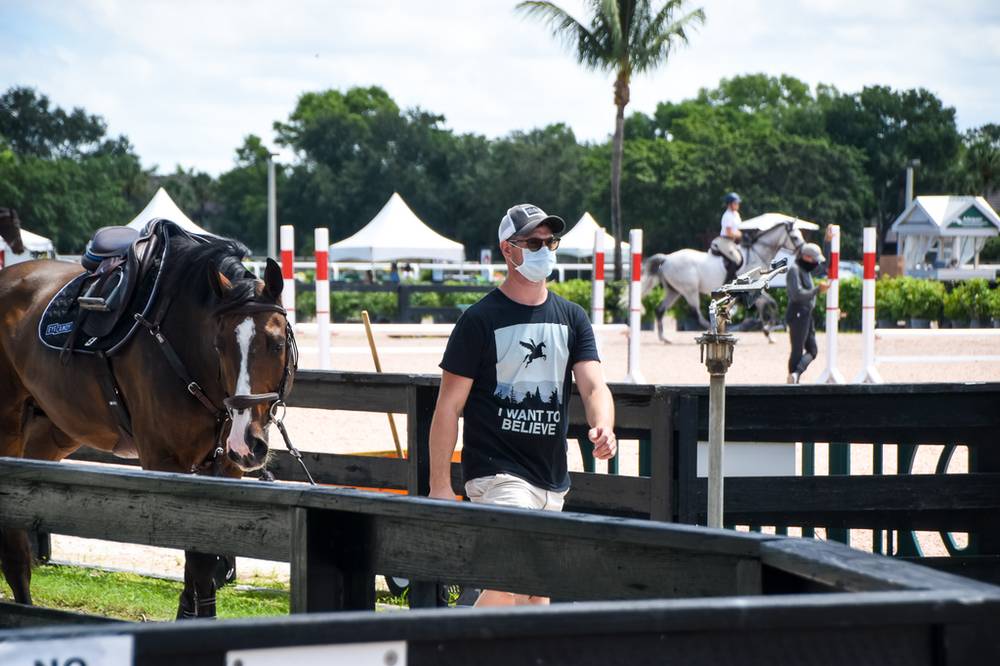

New research from the University of Kentucky’s Martin-Gatton College of Agriculture, Food and Environment suggests that performing “air sampling” at major equestrian events could offer a new way to monitor and track the contagious equine herpesviruses.
Researchers studied temporary stabling facilities at eight international equestrian events in Spain and the United States. They collected 37 air samples and 205 surface samples over 10 months and tested each for EHV-1 and EHV-4 strains of the equine herpesvirus, two of the most commonly spread at competitions. The findings were published this month in the Equine Veterinary Journal.

Air samples were collected over a period of six hours, according to the study. Researchers found EHV-1 in 20 of 28 air samples collected in Spain, three of three air samples from Florida and three of six air samples from Kentucky.
EHV-4 was also recorded in the collected air samples, but the pattern varied by location and possibly by season, the study said. EHV-4 was not found in the Florida samples. But it was detected in 12 of 28 samples from Spain and five of six from Kentucky.
“EHV-1 remains a major concern across the horse industry,” said study author Lutz Goehring, professor at the UK Gluck Equine Research Center in a press release. “The virus can cause respiratory disease, abortion and equine herpesvirus-associated myeloencephalopathy, a neurologic condition that can leave horses unable to stand.”
EHV outbreaks are becoming an annual contagion event around the world. In 2021, an outbreak in Valencia, Spain, prompted the International Equestrian Federation to fund the study, which aimed to find earlier ways to detect viral activity during competitions. More recently, a horse competing at HITS Culpeper at Commonwealth Park in Virginia was euthanized after testing positive for EHM and displaying neurological symptoms. Fifty-five horses on the show grounds were quarantined in April.
“Our goal was to find out whether there are other options besides daily nasal swab sampling,” Goehring said in a statement. “Air sampling gives you a way to look at a group environment without going horse to horse.”
The study concluded that no significant difference was found between air samples collected during afternoon hours during more horse show activity versus overnight. It suggests that the timing of the sampling may not have much effect, the study said.
Researchers were unable to determine how far the virus can travel through a barn, or target a specific horse that may have contributed to a positive air sample. The study relied on molecular detection of viral DNA.
The findings show that viral material may be present in shared event spaces even when no horses are showing obvious warning signs, according to a press release.

“We were surprised by the outcome,” Goehring said in a statement. “Herpesviruses can reactivate from a sleeper state, similar to the reappearance of a ‘cold sore’ in people. We thought reactivation in horses would be rare. We were surprised by the frequency of detection. We did not detect the numbers we typically see with induced, experimental infections. Our results suggest a fairly small plume present at event centers or barn areas, even without reported clinical problems at the time.”
Traditional surveillance measures depend on repeated nasal sampling, which researchers aid takes time, adds labor and can test the patience of both horses and handlers. Air sampling draws on public health work used in shared indoor spaces, similar to testing from the COVID-19 pandemic.
“It could offer a practical, noninvasive way to monitor group settings such as a barn aisle, rather than relying only on repeated individual horse testing; however, sampling equipment is currently too pricey to be implemented on a large scale,” Goehring said in a statement.
Horse owners can lower their risk of EHV by keeping vaccinations current, limiting direct contact between unfamiliar horses and avoiding sharing equipment, especially at large events like horses shows. For more biosecurity and safety tips, click here.
“There’s no reason to panic, but we need to take this information and find better ways to make sure horses are safe at these events,” Goehring said in a statement. “That can mean clearer do’s and don’ts for horse people, better biosecurity and more thought about how to reduce spread in shared spaces.”