


Editor’s Note: This story discusses death and the science around dissecting an animal, which may be distressing for some readers. In addition, it includes images from the event. Reader discretion is advised.
What can we learn from the horse even after he’s taken his last breath? It’s a morbid thought if you linger on it for too long. But if your appetite for knowledge and yearn to do better for the horse drives you each and every day, like it does for these three professional horsewomen, there’s a lot to learn from witnessing an equine dissection.


I was lucky enough to be invited to a three-day dissection, which took place in Tampa, Fla., this month. It was hosted by three equine medical professionals: Lorre Mueller, a registered equine osteopath with Trinity Equine Services; Gabby Hale, a nationally certified through an independent examination board (NBCAAM) equine body worker with Victory Equine Services; and Dr. Kailyn Van Horn, a veterinarian (DVM, CVMMP) of Sun Coast Equine Veterinary Services.
Lorre came to Tampa to host the event after Gabby participated in a dissection with her in Utah. A six-year-old Quarter Horse gelding was donated for the event in Florida. He had a history of lameness from a young age, including a fractured navicular bone, other navicular changes and additional hoof-related soft tissue and bone strains that meant he was living in chronic pain. Despite surgery, years of veterinary care, injections and special shoeing, it became impossible for him to live pain-free.
The horse was humanely euthanized on the morning of the first day of the event. His legacy would go on to teach a group of about 25 participants who came from near and far to learn from what they saw in his body. Most participants were professionals in the equine space, some body workers, nutritionists or veterinarians. Others were curious horse owners, like me.

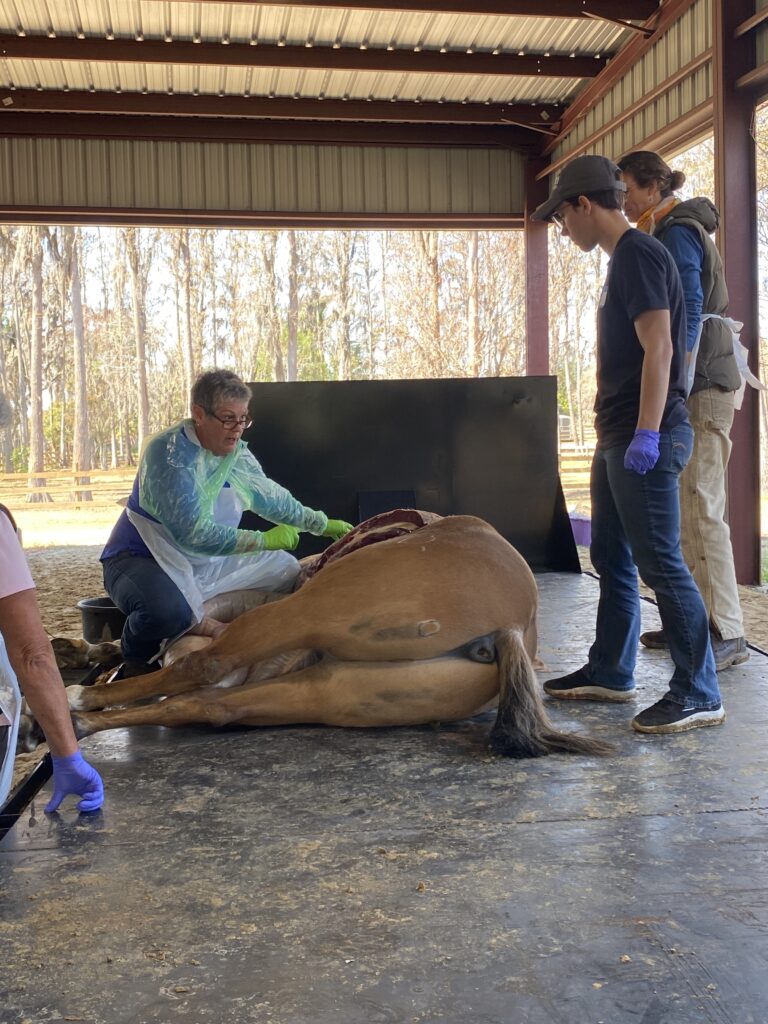
Lorre told me the goal is to reach an even broader network of horse people with these hands-on clinics, like trainers and even show judges. It’s hard to unsee and not feel something when you witness the repercussions of what people do to horses and the effect it can have on their bodies. But the goal overall of the event is to visually show how the equine body works and connects, and how it can perform as an athlete.
“If you are interested in what true collection means, what the horse has to do in his body to achieve that, and how you can better help them do that, this is the clinic for you,” reads the description of the dissection event on Lorre’s website. “Learn about the muscles required to achieve self-carriage, how the horse uses itself to become light on the front end, the role of the thoracic sling and neck in the process. The horse is elevating his back not lifting it and it is an amazing simple process when we can help them do it correctly.”
On the first day of the dissection, Gabby and Lorre worked carefully to remove organs, from the stomach to the liver to the intestines. While the gelding was mostly free of stomach ulcers, it was interesting to find evidence of hind-gut ulcers, something that is often difficult to diagnose and treat successfully. It was also incredible to see just how long the intestines are, and how carefully they are folded into the abdomen of the body. It’s no wonder colic risk is so high among our equine friends when you see just how delicate these internal structures really are.
We also examined a hind leg on the first day, seeing up close how fascia, the dense fibrous tissue that acts as a protective web around muscle and soft tissue, works across the body. I found the fascia to be tougher than I ever envisioned in my head, and it gave me a better understanding of why myofascial release helps my horse in his body work routine.


And finally, on that first day, we examined the matrix of muscles that work to create the topline over the horse’s back – think strong, thick muscles that work to protect and support the spine. This led to a long discussion about our riding and training practices.
Lorre was pretty blunt in the way she described how we do not in fact want these important muscles to “lift” when we are describing riding in self-carriage, as so many trainers often say. “Elevate” is the more appropriate term, because it describes using the core, and shifting the weight onto the hind-end in order to make the front-end of the horse light in its way of going. That was the eureka moment for me.
A dissection clinic is probably not for everyone. There are sights and smells that are hard to forget. But the learning opportunity it provides is truly one-of-a-kind. I appreciated the opportunity to see and learn but most of all to then discuss it with professional, educated horse people around me. It forced me to think hard about my own riding practices and gave me insights I will carry with me to every new horse I meet, ride and care for.
Want to hear more about Justine’s experience at an equine dissection? Tune into Episode 145 of the Heels Down Happy Hour Podcast to hear the full discussion.